Software Prototypes and Feasibility Studies with AI
THE COST OF EXPERIMENTING IS COLLAPSING
NOT SIMPLY THE SAME THING FASTER
For decades software development was marked by a high barrier to entry. Before a product could be judged in any real sense, requirements had to be structured, technical decisions prepared, interfaces designed, architectures built and considerable development resources committed.
Those costs acted as a filter. Only a limited share of conceivable product ideas ever reached a stage of development at which a sound judgement became possible.
AI-assisted development changes that filter. It removes neither technical complexity nor the need for good architecture. It can, however, considerably accelerate implementation, the generation of variants, technical research and iteration.
As a result, a coherent functional state of development can be reached far earlier.
The decisive effect therefore does not lie only in delivering existing projects faster. The economic threshold falls at which a new software or product idea can be examined seriously.
Anyone who uses AI coding only to program faster is using the smaller part of it.
The obvious view of AI coding is: existing software projects get faster. That is true, but it describes only part of the change.
Strategically more important is that the set of ideas which can be examined economically grows larger.
A new application no longer has to be described for months as a concept alone. A specialised technical system, a simulation environment, a visual planning system or a new digital product idea can take shape as coherent software far earlier.
This does not merely work through the existing project pipeline faster. Ideas enter development that would previously not have crossed the economic entry threshold of a classic IT project.
The relevant change therefore does not lie in productivity alone. It lies in a larger entrepreneurial search space.
FROM EARLY COMMITMENT TO EARLY INSIGHT
Classic development models force companies to select early. Only a few ideas receive a budget. Those ideas are then pursued comparatively far, because considerable resources have already been committed.
When the cost of early technical development falls, this order can be partly reversed. More product ideas can first be brought to a real technical level. Only then does one have to decide which approaches justify further investment.
Product development thus shifts from a logic of early commitment to a logic of early insight.
That does not mean producing as many experiments as possible. What matters is reducing uncertainty at the points where it actually affects entrepreneurial decisions.
Examine more. Learn earlier. Discard weak approaches sooner. Build out strong ones with more purpose.
For new products, the detailed specification is an elaborate form of guessing.
Software development is traditionally understood as carrying out a decision that has already been made. First it is defined what is to be built. Then it is developed.
For new products that separation is only of limited use. Part of the decisive insight arises during development itself.
Only a real interface shows whether an idea for operating the system holds. Only real data makes it visible whether a data model is appropriate. Only a working system core shows whether architecture, performance and product logic fit together. Only a usable system permits a realistic assessment of what a product idea can actually become.
Development therefore produces more than software. It produces information about the future product.
In an early product phase, a solid state of development can produce more insight than another round of abstract specification.
A click-through prototype shows what a product could look like. It does not show whether it works.
The experimental character of this approach does not mean that only small or provisional software comes out of it.
What is experimental is the openness of the process of finding out.
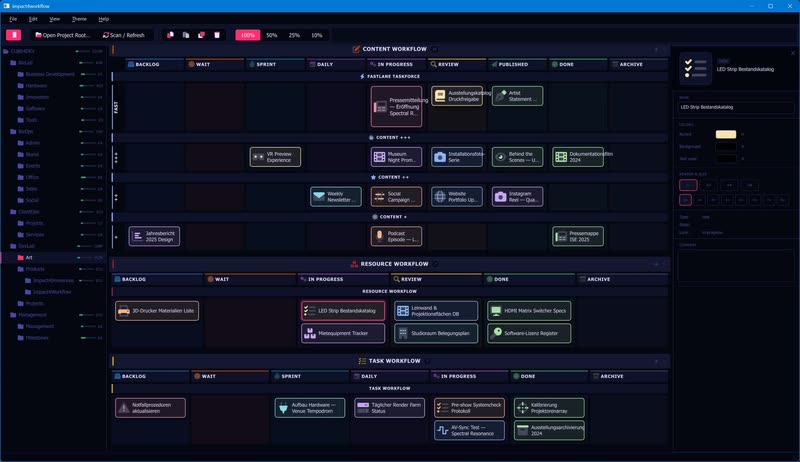
Even a technically demanding desktop application can be developed experimentally, if its purpose is first of all to test a product idea in reality and to sharpen its direction further during development.
An early state of development can already consist of several connected elements: a real user interface, domain logic, data storage, visualisation, persistence, import and export functions, communication with external systems, or a solid technical core.
The work therefore goes considerably beyond a visual click-through prototype.
The aim is as much solid product reality as possible in as short a development time as possible.
A project that is stopped after one week can be the most successful of the year.
Not every product idea should be developed further.
An early state of development can show that an idea does not hold technically, that its complexity was underestimated, or that the expected benefit does not justify the effort.
It can equally become visible that the originally planned solution is needlessly complicated, that the technical route can be simplified, or that another part of the idea holds considerably more potential.
These outcomes are not a failure of development. They are part of its economic value.
An early, well-founded decision against an idea can be considerably more sensible than a late correction after extensive investment.
The value of early development therefore lies not only in creating new products, but also in the quality of the decisions about those products.
Example projects
3
Ask about this
THE COST OF EXPERIMENTING IS COLLAPSING